
Suspect a slab leak?
We respond quickly across Carson to locate and address slab leaks before they worsen.
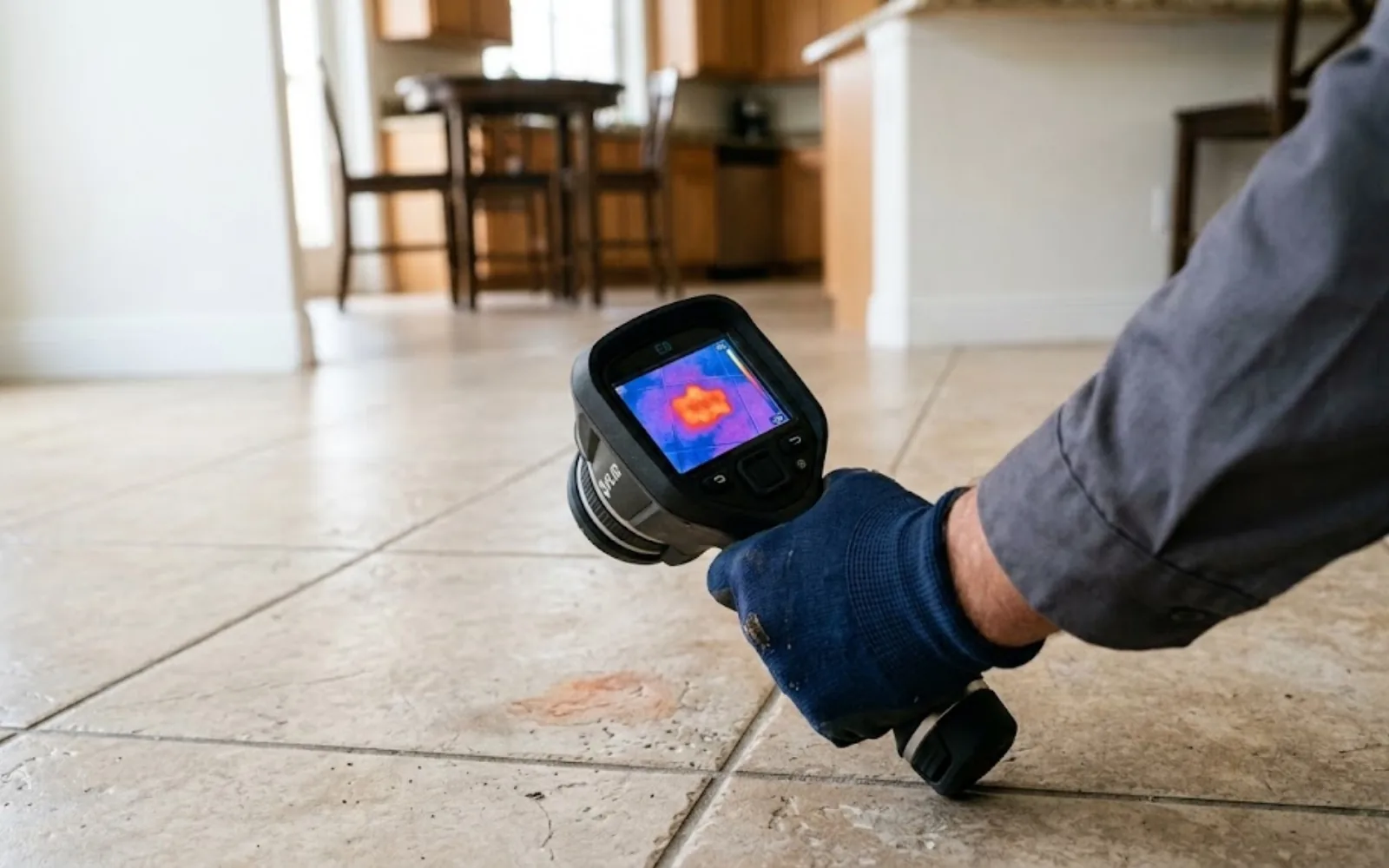
Warm Floor Spot or Rising Water Bill? It May Be a Slab Leak
A slab leak happens when a water line running underneath a home's concrete foundation develops a leak, usually from corrosion, ground shifting, or an original installation defect. Because the pipe is encased in concrete, the leak often isn't visible directly, showing up instead as a warm patch on the floor (if it's the hot water line), a sound of running water when nothing's on, or a steady rise in the water bill.
Left unaddressed, a slab leak can erode the soil beneath the foundation over time and, in some cases, contribute to cracking in the slab itself. It's a problem worth addressing promptly once suspected, not something to monitor and wait on.
Signs of a Slab Leak
Warm Area on the Floor
If the leak is on the hot water line, the slab above it often feels noticeably warmer than the surrounding floor.
Sound of Running Water
Hearing water running when every fixture in the house is off is a strong indicator of a leak somewhere in the system, including possibly under the slab.
Unexplained High Water Bill
A slab leak can lose a significant amount of water continuously without any visible sign inside the home.
Cracks in Flooring or Walls
In more advanced cases, shifting caused by a slab leak can show up as new cracks in tile, flooring, or nearby walls.
Slab Leaks in Carson's Slab-Foundation Homes
Many homes built in Carson from the mid-20th century onward use slab-on-grade foundations, which means water supply lines run beneath the concrete rather than through an accessible crawl space. That construction style is common and generally reliable, but it means a leak in one of those buried lines requires either accessing it through the slab or rerouting the line entirely, since simply patching isn't possible without exposing the pipe.
We use acoustic detection equipment to pinpoint a slab leak's location before recommending a repair approach, since guessing at the location and breaking concrete in the wrong spot adds unnecessary cost and disruption. Once located, there are usually two paths: accessing the specific point through the slab to repair that section of pipe, or rerouting the water line entirely through an accessible wall or ceiling path, bypassing the slab altogether.
Rerouting is often the less disruptive option, especially for older homes where the existing under-slab pipe material is likely to develop additional leaks elsewhere along its length in the coming years anyway. We'll walk through both options with real cost and disruption tradeoffs specific to your home's layout.
Our Slab Leak Process
Acoustic Location
Pinpointing the leak's exact position before any concrete work is considered.
Assess Repair vs. Reroute
Comparing direct slab access against rerouting the line through an accessible path.
Execute the Chosen Fix
Minimal, targeted slab access or a clean reroute, whichever fits your home best.
Pressure Test and Confirm
Verifying the repair holds and the leak is fully resolved before finishing.
Why Choose Us for Slab Leak Repair
Precise Location First
Acoustic detection avoids unnecessary concrete demolition.
Rerouting Expertise
An alternative to slab access that's often faster and less disruptive.
Honest Cost Comparison
We explain both repair paths clearly so you can choose what fits your home and budget.
Fast Response
Slab leaks are scheduled promptly given the ongoing water loss and potential for foundation impact.
What Affects the Price of Slab Leak Detection & Repair
We can't give an accurate number without seeing the job, but these are the real factors that move the price up or down.
Direct repair vs. rerouting
Rerouting through an accessible wall or ceiling path sometimes costs less than breaking through concrete, depending on the home's layout.
Length of the reroute path
A short reroute costs less than one that has to travel a long distance to reach a fixture.
Flooring above the slab
Tile or stone flooring adds cost to a direct-access repair compared to carpet or vinyl.
Direct Slab Access vs. Rerouting
| Factor | Direct Slab Access | Rerouting |
|---|---|---|
| What it involves | Breaking into the concrete at the leak's exact location | Running a new line through an accessible wall or ceiling path |
| Best for | A newer system with an isolated, unusual failure | Older under-slab lines likely to develop future leaks elsewhere |
| Flooring impact | Requires removing flooring above the access point | No slab or flooring disruption |
| Long-term outlook | Addresses this one leak | Removes the aging under-slab section from service entirely |
Not always. Rerouting the line through an accessible wall or ceiling path is often possible and avoids breaking concrete. We'll explain both options based on your home's layout.
It's worth addressing promptly. Beyond wasted water, a long-term slab leak can erode soil under the foundation and contribute to structural issues.
Acoustic detection equipment listens for the specific sound of water escaping a pressurized line, letting us narrow the location closely before any concrete work.
Some homeowner policies cover slab leak repair or the resulting damage, depending on the cause and your specific policy. We can provide documentation to support a claim.
Where Carson Pro Plumbing Works
Get Your Slab Leak Located
Call for slab leak detection and repair in Carson, CA.
📞 Call (310) 424-7510